


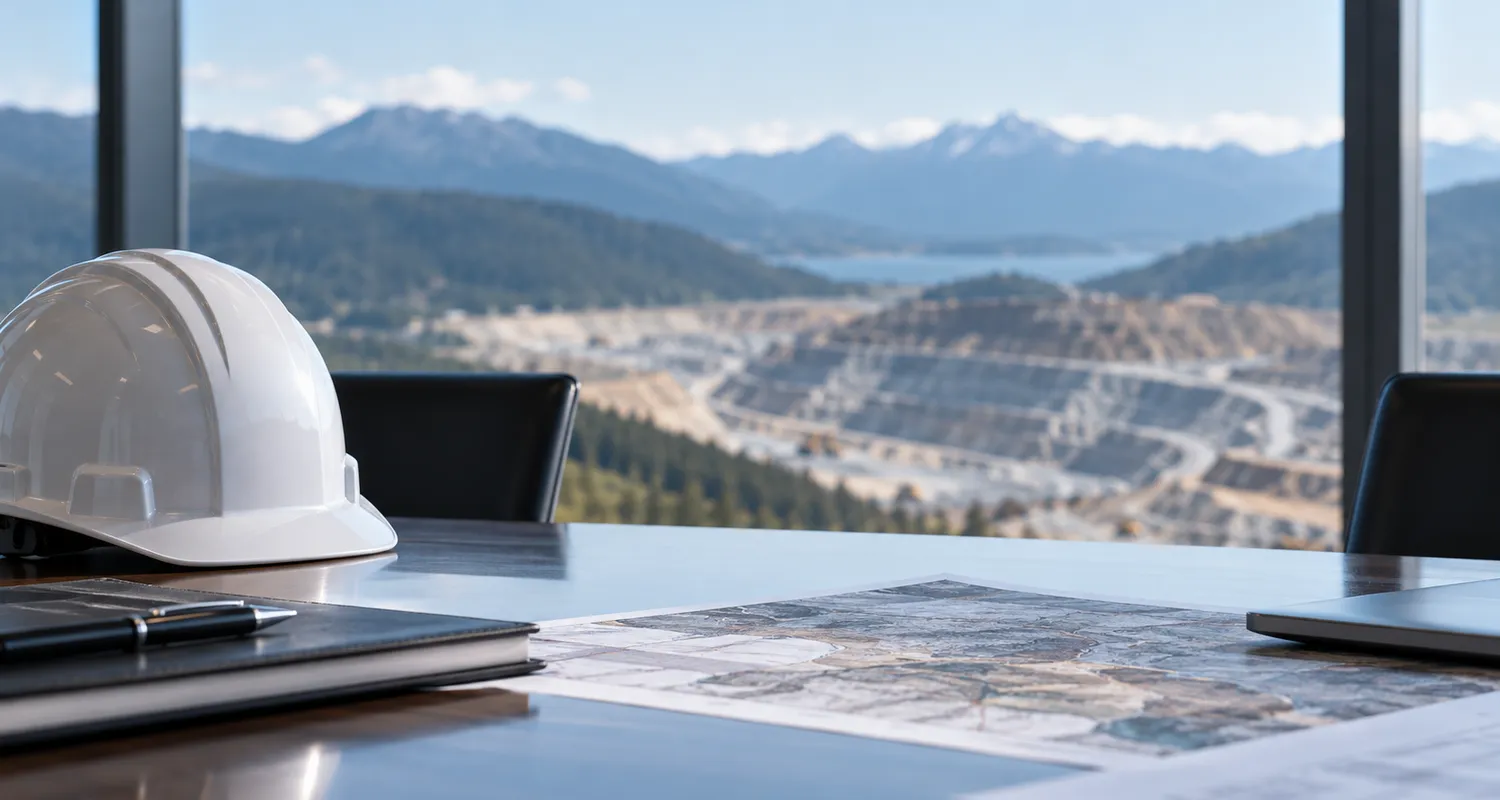
In mining, the asset gets the headlines, but the people running it decide whether the story ends well. This is especially true across the junior and mid-tier space, where two companies can be sitting on comparable geology and still arrive at very different outcomes, and the difference is almost always the leadership team: how it is built, how it is incentivized, and how well a board recognizes when that team needs to change.
Recruitment in this part of the industry carries a particular kind of pressure. Junior and mid-tier companies rarely have the balance sheet to outbid a major on salary, they operate with a fraction of the management depth, and they ask executives to be technically credible, capital-markets fluent, and comfortable doing the work themselves all at once. Getting that hire right can compress a decade of value creation into a few years. Getting it wrong can sink a company that never had a problem with its rock.
To explore what separates a strong mining leadership team from a struggling one, Pender & Howe Director, Executive Search, Ryan Graham, sat down with Hannes Portmann, CFO of Cadillac Mines, whose background includes mining engineering, finance, investment banking and multiple executive leadership and board roles in the mining industry. Few people have watched leadership teams succeed and struggle from as many seats at the table.
Incentives are the Differentiator
You have looked at mining companies as an executive, an investor, and a board member. In your experience, what actually makes junior and mid-tier companies successful?
There's an old adage in mining that a great management team can take a marginal asset and make something of it — and I've seen that play out. The flip side is equally true: a weak or misaligned team can squander a genuinely good asset.
To be clear, the quality of the asset definitely matters. You need something of substance to work with, or even the strongest team is fighting an enormous headwind.
The differentiator, in my experience, is equity alignment. When people have real skin in the game, they treat the company as their own. They run through brick walls, think entrepreneurially, and exercise capital discipline. When management doesn't have that exposure, it comes back to incentives, and it shows up everywhere: how hard people work, how carefully they spend, how much initiative they take.
CFO of Cadillac Mines
„The differentiator, in my experience, is equity alignment. When people have real skin in the game, they treat the company as their own. They run through brick walls, think entrepreneurially, and exercise capital discipline.“

Hannes Portmann
What to Look for in a Hire
When you are hiring an executive or building a management team, what traits give you confidence they can execute, and how much can a strong hire really change the trajectory of a junior or mid-tier company that doesn't have the deep management bench of a larger organization?
It's a bit different depending on the role. For highly specialized technical positions, like metallurgy, you need real subject matter experts, people with genuine experience at the right scale and complexity, because those things can be very nuanced and very specific. For leadership roles, it's more a question of breadth of skills and a willingness to make decisions without perfect information. In mining, you often don't have all the information before you have to make a call.
When you get that leadership hire right, the direction of the organization can change a fair bit. Somebody who's willing to move up and down the food chain, roll up their sleeves, dig into things they might have delegated in a bigger organization, and still drive strategy on top of that, can have a profound impact. And they set the culture. If they're hard-driving, thoughtful, creative, and willing to work hard, that has a massive cascading effect down and through the organization.
That also connects directly to access to capital. We're operating in a world of many hundreds of publicly listed mining companies, where people's attention spans are very short and they have many investment alternatives. The moment you're not forthright with the market and your disclosure, people just say, okay, I'll move on to the next thing and get their gold or copper exposure somewhere else. A consistent track record of setting the right objectives and delivering them is self-fulfilling. It attracts capital and it attracts good people, because people want to be associated with winners, and with people who are honest, decent, and hardworking.
If you are the opposite of those things, people say, "I would never go work for that organization," and then you are left in the lurch where you are always getting the C players.
Building a Leadership Team that Evolves with the Project
A company can look completely different as its asset advances from exploration to development to production. How should boards think about evolving the leadership team through that journey?
It absolutely needs different kinds of people to take the reins at different times. But I don't necessarily think that means you need a different CEO for the exploration years, the development years, and the operating years. What you need is a leadership team that trusts one another enough, and is comfortable enough in their own skin, to recognize that different people become the key cog in the wheel at different times. In the first few years, it's usually your Head of Exploration, as you discover and build out a compelling resource base.
Then there's a moment when you need to raise real capital, and your CFO becomes the key player. Then you go build a mine, and it's your COO or VP of Operations running that capital project. And then you move into operations, and your operating team becomes the key cog in the wheel.
What makes a great CEO is the ability to hire the right team, empower people and hold them accountable, and keep the band together through these various phases. While the CEO is ultimately the leader, she/he also needs the confidence to step back from the ‘day to day’ or ‘phase to phase’ leading role which then allows them to remain focused on the strategy and vision of where the organization is ultimately aspiring to go.
Competing for a Scarce Pool of Talent
There is a relatively small universe of executives who have taken projects through every stage successfully. How competitive is the market for proven mining talent, and what can a junior or mid-tier company — which can't compete with a major on cash compensation or job security — offer to convince an exceptional executive to make that move?
Extremely competitive. Mining asks you to have a pretty deep understanding of a wide range of things at once. Even if you're a deeply experienced mining engineer, you also need to understand capital markets, capital allocation, how the stock market works, and how research analysts play a role in all of it. And if you're building a billion-dollar capital project, you need to understand the technical side too. For instance, what concrete costs, what it costs to bring power in from however many kilometres away, and you still need to understand the geology well enough to know whether you actually have something.
Finding people with real breadth and depth across all of that is inherently difficult. And when you find the good ones, you can often end up finding them in groups because they tend to associate with other people who are strong, and those are the people you want to support, either by working with them or investing in them.
Given how scarce that talent is, the lever a junior has is equity exposure. If you're a VP at the largest company in your space, you probably have a very healthy salary, a solid annual bonus, some LTIP exposure every year, and a wonderful career that would be the envy of a lot of people. Some people are happy to stay on that track. Others reach a point where they say the world's a big place and decide to take their skill set down cap instead, trading a VP title for a real shot at being a CFO, COO, or head of exploration, with real equity exposure.
If you're a meaningful contributor to growing that smaller business, it can be significantly more rewarding both financially and professionally than remaining with a larger cap organization. That doesn't appeal to everyone, but for the people it does, the pitch is simple: we believe if we execute this plan, we could take this business from X to 10X. If that interests you, here is an equity package. And then it's important you also open your wallet and buy some of that stock yourself, because that shows sincerity that you believe it too. In all of this, there is perfect alignment between the executive and the company’s shareholders. The executive only wins if investors are making money.
What Boards should be Assessing
How challenging is it for a board to recognize that the person who got the company to where it is today might not be the right person for what comes next, and when the time comes to make that hire, what are you personally looking for?
I don't think recognizing that moment is as challenging as people assume, though it depends on the experience of the board. A first-time board might not appreciate these dynamics, but more seasoned boards have usually seen this kind of evolution play out before, at companies of different shapes and sizes.
It really comes down to a culture of trust, and having leaders in those ranks who are focused on the company's name, not their own. When everyone is aligned on making the company a success, you're far more willing to defer the spotlight to whoever's the key player in that moment, and everybody supports one another.
As for what I look for once that decision is made, it's certainly not one thing, but cultural fit is tremendously important. Trying to convince a VP at a big-cap company to come in and be something they're not at a more junior, entrepreneurial company almost never ends well, even if the person has all the right skills on paper. You need someone with the willingness and ability to oscillate between strategy at the highest level and, when it comes down to it, opening powerpoint to build the presentation themselves or book the flights to next conference, because when you're one of ten people trying to make a go of it, that's simply part of the job.
That cultural fit is also probably the hardest thing to assess, because judging technical skills, while not easy, is at least more tangible and quantifiable. I can look at the six mines someone worked at and see how the resources grew and get a good sense that they're a pretty good geologist. It's much harder to know whether someone has softer skills and the hunger to get a report or a strategy document done on a Friday night, when they have the option of just checking out instead.
Lessons from Experience
Is there anything you have learned about hiring that you would not have appreciated fifteen years ago, and if you were advising the board of a junior or mid-tier mining company with a strong asset, what is the biggest hiring mistake you would tell them to avoid?
Fifteen years ago, it came down to an ability to assess people, their technical skills and their motivations, and that is still true today. However, I'd hope that my ability to assess those things has gotten a bit better over time. But I think one thing that might be a bit of a counterintuitive answer is realizing it's okay to be wrong. Fifteen years ago, I would have thought you could never come back from a bad hire. Now I know that as long as you did your diligence and used your best judgment at the time, sometimes it just doesn't work out, and you have to be willing to deal with it.
Other than very, very extreme cases, six months usually isn't long enough for someone to do anything fatal to the business. But you cannot let bad hires linger, because their negative impact on the organization is profound. It's hiring slow, fire fast, and it's something you get much more comfortable with, as you become more experienced and more senior.
If I had to point to the single biggest mistake boards make, it's defaulting to the large-cap roster, assuming that because someone had a VP role at a big company, you can pull them out of that environment and expect them to repackage that experience for the junior and mid-tier world. There are people who can do it, and when it works out, it works out great.
But taking away all of that large-cap infrastructure, and stripping things down to the bare bones where you're one of five or ten people in the entire organization trying to make a junior or mid-tier mining company work, is far, far from a guarantee. This is where understanding the persons core beliefs and motivations makes all the difference.
About Hannes Portmann
Hannes Portmann is Chief Financial Officer of Cadillac Mines, a gold exploration and development company listed on the Toronto Stock Exchange. He brings a rare combination of technical and financial grounding to the role, having trained as a mining engineer before earning an MBA and a CPA designation and spending several years at PricewaterhouseCoopers.
Hannes began his career at Price Waterhouse Coopers before joining what would become New Gold in 2008. Over a decade there, he took on progressively broader responsibilities, spanning corporate development, investor relations, human resources, and exploration oversight, before serving as CEO. He later served as CFO of Marathon Gold and spent three years outside the industry with real estate and golf-course developer Cabot, before returning to mining with Cadillac Mines. Hannes previously served on the board of SilverCrest and currently serves on the board of ATEX Resources.
Across his career, Hannes has held a rare vantage point on mining leadership, having sat on the executive, investor, and board sides of the table.
Work With Pender & Howe on Your Next Mining Search
With offices across Toronto, Montreal, Vancouver, Calgary, Edmonton, Boston, and New York, Pender & Howe combines boutique-level partner involvement with deep sector intelligence across technology, life sciences, industrial, consumer goods, and professional services.
Pender & Howe partners with exploration, development, and producing mining companies to identify and attract exceptional talent across technical, operational, executive, and corporate functions.
We specialize in the mining sector, supporting organizations at every stage of the mining lifecycle — from grassroots exploration to large-scale production. Our team understands the technical complexities, commercial pressures, and leadership demands unique to the mining industry.